Table of Contents
Uses of Ceramics in Engineering
Engineering today places increasing emphasis on long-lasting materials, high operational reliability, and reduced maintenance downtime. As industries move toward efficiency-driven operations, the use of ceramics in engineering has become more prominent than ever. The shift is not surprising as ceramics bring together outstanding durability, chemical resistance, temperature stability, and long-term performance across diverse engineering environments.
Across mechanical systems, industrial machinery, energy production, and precision equipment, ceramic materials offer capabilities that metals and polymers cannot match. For engineers and operations teams, these materials deliver an extraordinary combination of strength and reliability. As a result, the top uses of ceramics in engineering continue to expand across industries such as chemical processing, oil & gas, manufacturing, mining, water treatment, and high-precision industrial systems
Companies like CeramForge, leading ceramic manufacturers, play a critical role in designing and supplying advanced ceramic solutions for engineering applications. Their industrial-grade ceramics offer consistent performance, making them the preferred choice across engineering segments where equipment failure is not an option.
Ceramics Solutions in Modern Engineering
The rising adoption of ceramics in engineering stems largely from their material properties and the operational advantages they offer. Ceramics withstand aggressive working conditions—abrasive contact, corrosive liquids, high-pressure cycles, and continuous thermal exposure—without deteriorating or deforming. These characteristics make the use of ceramics in engineering significantly more practical and commercially valuable compared to traditional materials.
Industries operating in chemical, mechanical, or heavy-duty processes rely on ceramics because they provide predictable performance even under stress. While metals may corrode or require frequent replacements, ceramics offer long service life. Their stable behavior at elevated temperatures and their resistance to aggressive fluids contribute to the overall dependability of engineering systems.
In an environment where cost-efficiency and uptime are key performance indicators, ceramic components reduce long-term operational expenses. They enhance equipment reliability and prevent shutdowns caused by wear or corrosion. These advantages explain why the top uses of ceramics in engineering directly contribute to better performance outcomes across multiple engineering disciplines.
Industrial Applications of Ceramics in Engineering
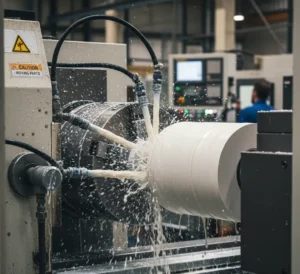
Most engineering applications use ceramics where equipment must withstand abrasion, repeated mechanical loading, or exposure to chemicals. Some of the top uses of ceramics in engineering include:
- Flow Control Components – Ceramic valve seats, plugs, and liners maintain sealing integrity in abrasive and corrosive fluid environments.
- Pump & Metering Systems – Ceramic plungers, sleeves, and pistons maintain dimensional stability under continuous high-pressure cycles.
- Bearings & Wear-Resistant Parts – Industrial ceramic bearings and wear rings reduce friction and extend equipment life in high-speed machinery.
- High-Temperature Engineering Systems – Ceramics demonstrate exceptional performance in furnaces, heating systems, and thermal processing equipment.
- Cutting, Grinding & Abrasive Tools – The hardness of industrial ceramics enables precision in machining operations and surface finishing processes.
- Electronic & Semiconductor Components – Advanced ceramics offer insulation, heat resistance, and stability required in sensitive high-precision applications.
These applications reflect just a portion of the overall uses of ceramics in engineering, demonstrating how widely industrial ceramics influence performance in complex engineering environments.
The most significant benefit of ceramics in engineering is their exceptional resistance to abrasive wear. In rotating, sliding, or high-impact machinery, industrial ceramics outperform metals by maintaining surface integrity over long periods. This makes them invaluable in equipment exposed to sand, slurry, mechanical friction, or aggressive particulates.
For industries that cannot afford downtime, these benefits collectively reduce maintenance frequency, enhance equipment lifespan, and ensure consistent operational performance. This explains why engineering teams across sectors continue to adopt industrial ceramics from trusted ceramic manufacturers.
Uses of Industrial Ceramics
Many ceramic industries plays a crucial role in advancing the uses of ceramics in engineering by supplying high-performance ceramic components for demanding industrial applications. Their focus on industrial-grade consistency, engineering reliability, and material expertise differentiates them from generic ceramic manufacturers.
The company works closely with engineering teams to understand operational challenges such as abrasive flow, pressure cycles, temperature swings, and corrosion exposure. This application-level understanding enables the supply materials and components that match the required performance criteria.
Ceramics also contribute to engineering efficiency in abrasive systems. Their extremely high hardness enables them to withstand high-velocity particulates, slurry movement, and mechanical wear. Many pump and flow systems rely on ceramic components to maintain sealing and reduce leakage risks.
Manufacturers design ceramic components that align precisely with industry needs—offering advanced material selection, quality control, and finishing processes. Their industrial ceramics are tailored for real-world engineering operations, supporting long-term equipment reliability and engineered performance.
Their production processes emphasise quality—from material formulation and pressing to sintering and final finishing. Each ceramic product is engineered to support long-term reliability, ensuring that systems experience reduced wear, fewer failures, and improved operational continuity.
These aspects continue to support industrial companies looking for stable, dependable material solutions. Their experience across sectors like chemical processing, oil & gas, manufacturing, mining, and water treatment positions them as one of the most trusted providers of industrial ceramics for engineering applications.
Conclusion
The uses of ceramics in engineering continue to expand as industries move toward long-term performance, operational efficiency, and cost-effective maintenance. From wear-resistant components to high-temperature systems and corrosion-resistant applications, ceramics offer unmatched advantages that metals and polymers cannot replicate.
Across flow systems, industrial machinery, precision equipment, and high-pressure environments, the top uses of ceramics in engineering demonstrate their essential role in improving equipment reliability. Industrial ceramics are now integral to the engineering landscape, supporting systems that require stability, durability, and operational consistency.
For companies seeking performance-driven ceramic solutions, CeramForge delivers engineering-grade ceramic components built for demanding industrial conditions.